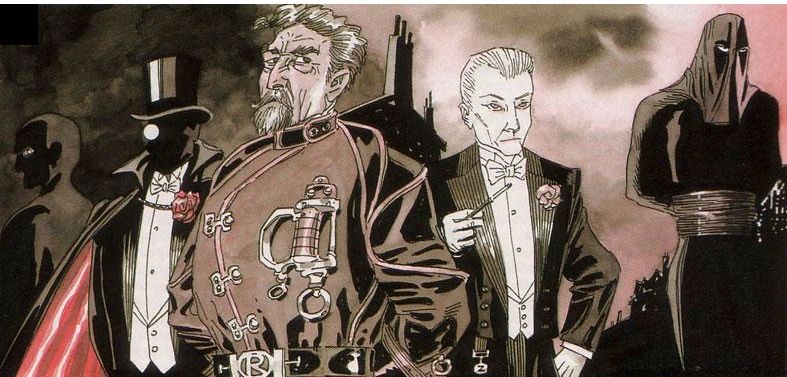
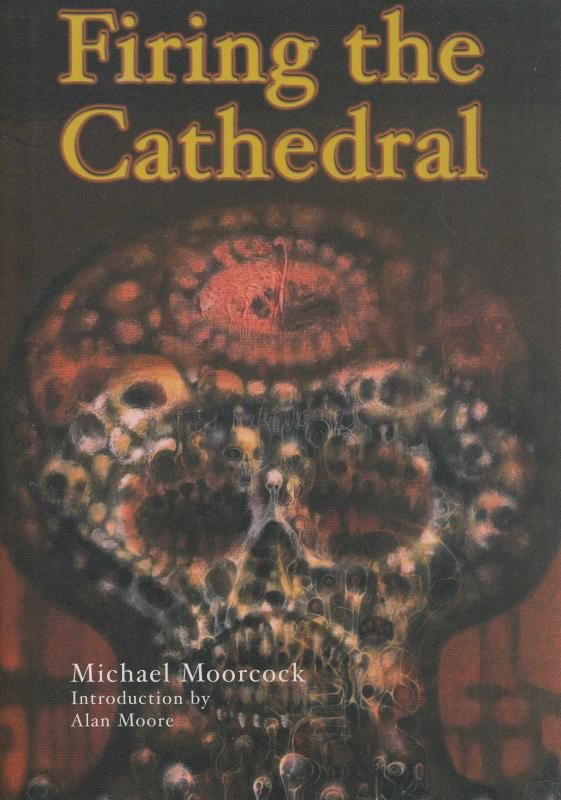
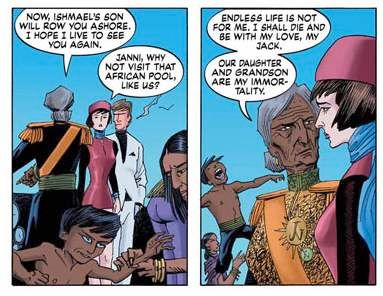
It might be too early still to talk about Janni Dakkar, but let's see where it gets us.
Since its conclusion a little more than a year ago,
Century
has come to mark a major turning point in Moore and O'Neil's massive,
multi-cast literary crossover, the League of Extraordinary Gentlemen;
having dragged its core members through disaster, madness, heartbreak,
and, as it would seem, death, they have prevailed at last into that most
vacuous of cultural periods - our period, our time.
Departing from its earlier agencies that gave us the first two volumes -in company, if not in format-
Century marks the end of the journey Moore and O'Neil first set out for themselves in the
Black Dossier
(Volume III of the League series), witnessing in the process the
emergence of a central if not unifying theme: that of immortality.
It is a fitting choice, and one that the series' three -immortal- leads, Murray, Quatermain, and Orlando, use to great effect.
Set against the background of a world where the passage of time is far from inconsequential (
a la
Superman and Archie comics), each installment serves not only to
distance this new League from the immortal/mortal subplot long dominated
-but never directly addressed- by the mainstream, but also to set them
off on their own, more sober, direction. Delightfully, along the way the
story cameos another lineage of time-trippers, although while
Moorcock's Cornelius & co are free to step in and out of time as
they please, buffered no less by a temporary loss of identity that
blunts them against what has come before, Moore's League remain
entrenched in time, and perceive its effects in a more cumulative manner
(as far as I can recall, there has been nothing to suggest that the
Burning World allows for time hopping), often to ugly ends. And
tellingly so; the Cornelius Chronicles are full of moments when the
characters, far from the stalwart models of literary classics, who
appropriate instead the everyday Joe, begin to fragment whenever they
are forced to recall too much of their own past. Time, it seems, is a
burden.
The League, therefore, is left to seek out their own
means of amnesia, be it through madness (Murray), drugs (Quatermain), or
apathy (Orlando), all of this while some abstract storyline explodes
around them.
Century, more than culture, I feel, addresses how
our characters deal with time and change across a hundred year period,
while they themselves remain physically unaltered. It is because of this
last point that, time and again, an almost infantile-like disposition
seems to emerge from the group, placing them to stand closer with the
Cornelius gang, rather than the alternative, which we will come to a
paragraph later.
As far as Moore's work is concerned, however,
the themes are all too familiar: very few comic book writers have been
more than willing to leave their characters to their own devices and,
driven by something other than a desire to propagate a certain
franchise, allow to them their own natural ends.
"I would have
been basically going through all the decades of her life, with her
getting older in each one, because I liked the idea, at the time, of
having a strip in 2000AD with a seventy or eighty year old woman as the
title character."
-Alan Moore, on Halo Jones.
Here.
Janni
Dakkar is a different sort of character. Ever since that night in 1910
when she leapt into the seas against a full moon, directly after a
frightened Carnacki had woken up gesticulating about a certain
Moonchild, it has stayed with me that she, and not our many eyed
anti-Christ, was the coming change that our spectral investigator had
spoken of.
For one, unlike the core three, Janni isn't physically
immortal, and while this tends to sum up the generalized take on her, a
closer look will show that, being a fictional character in her own
right, her position up there with the rest of the fiction-verse is more
than a little assured, nurtured in part by her present and future fan
readership, and sowed no less by such capable hands as Moore's. In
Century &
Heart of Ice, as we will see, it is the choices she makes that sets her apart.
Every
one tends towards their own state of rest, to paraphrase Matchbright,
and either consciously or not we edge towards that condition that
requires the least energy to maintain. It is therefore no coincidence
that when we first see Janni it is to find her naked and unembarrassed,
carefree and at ease - right up to the point where Ishmael appears with
her father's summons. Later renouncing, as far as she can, her own
heritage, she swims out to sea to a passing schooner. When next she
returns to the mantle of Nemo, it is after she has been violated by the
very hands of those her father despised most, so that even as the
drawbridge of the Nautilus closes up and the vessel swallows her whole,
we are left with a feeling that her story is far from over, and that
what we have seen is little more than a temporary respite from the
impetus that led her to leave from Lincoln Island in the first place.

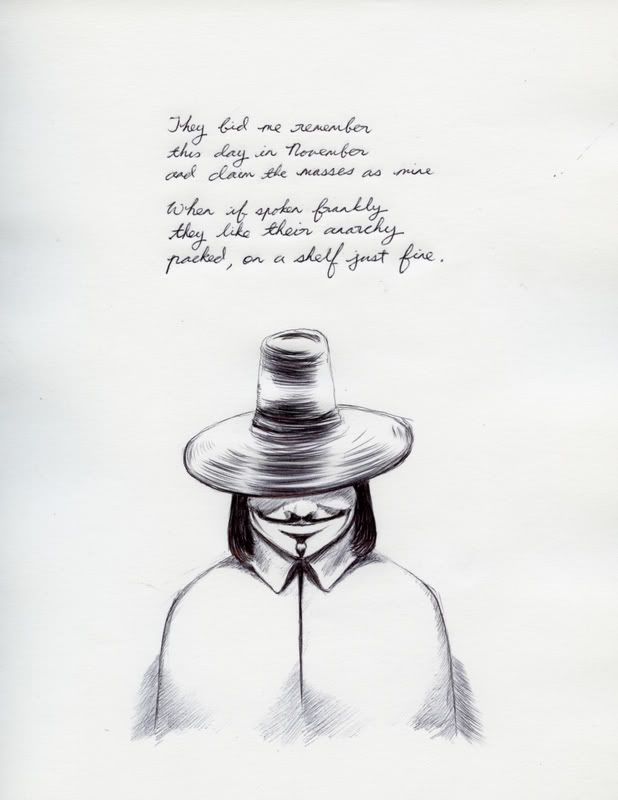
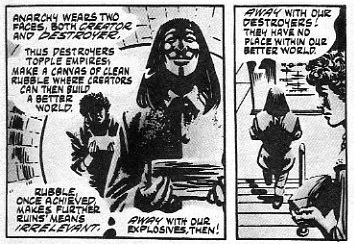
I
don't know if this panel left with me a strong enough impression upon
first reading, although by the end of V it had certainly taken on a
whole new meaning. It was only much later, when recoiling from the
effects of V, that it occurred to me that I wouldn't mind reading about
Evey Hammond's subsequent adventures, the challenges she would face as
creator rather than destroyer, simply because it was always so much
easier to fight *against* something, as evidenced by every other comic
on the market; I was sure, even then, that no one else would be able to
write something like that.
Lincoln Island, in occupying the part of what could be considered North
Korea in the world of the League, minus all the political alliances (but
not matrimonial ones), appears to remain the underdog throughout the
entire fourth volume of the League series. They will always be the
Destroyer, the thorn in the side of the Empire, keeping true to Prince
Dakkar’s split from England as promised at the end of Vol II. By the
time we reach 2009, Prince Hira seems more than keen on continuing this
line of the Dakkar dynasty, and it is only in Janni’s lifetime that
some other facet of the Nemo legacy is revealed. Given how bleakly the rest of our cast has turned out, I think that a welcome development.
It is her adventures, therefore, that picks up where Evey Hammond’s left off.
Before that she still has one more thing to see to.
In
Heart of Ice Janni has grown tired from walking in her father's shadow since reclaiming
her birthright, 15 years ago; so much has passed her way since then, in
fact, that she has become more than a little jaded, her own history
capped off by those two events that, however long ago, still inform her
entire character: her escape from Lincoln Island, and her rape by the
English. Subconsciously, we wonder if she hasn't been looking for some
way out when, almost on a whim, she announces her intention to revisit
one of her father's earlier, failed expeditions. (Far from a whim
perhaps, but the story's short format makes it so – and my only complain
about the installment; who would not have loved to see more perspective
shots of the Nautilus, A LA the Carrier in the Authority?)
Yet
there is more to this than a passing fancy. She has, by Ishmael's
account, outdone her father and, by her own hatred for the English as
well as her agency of the Nautilus, given form to that sentiment (two
qualities that Prince Dakkar also possessed); in short, Janni has come
as close to being like her father as she possibly can. Yet something is
amiss. Outwardly she tells Broad Arrow Jack that she is tired of
looting, and yearns instead for adventure, except that perhaps there is
some part of her that wonders how differently life would have been for
her father -and so her- if he had spent more time adventuring instead,
and if his most glaring of failures had turned out otherwise.
Of
Prince Dakkar's own trek through the Mounts of Madness we have only his
account from Volume II's New Traveller's Almanac to go on with, and
Kevin O'Neil’s rendition of Janni's adventure in
Heart of Ice
seems to mirror her father's journey for the most part, except for one
difference: where Prince Dakkar entered the Antarctica bitter and angry
about his wife's not giving him a son, and emerged maddened and
incoherent with his disappointment intact, it is his daughter who,
seeking adventure and escape, ends up finding for herself a new life
instead. Yet this involved her choosing as well; close to the end when
Janni reflects on her escape, we see an unnatural lens turned towards
her deceased father, whose time and era she reasons as no longer her
own, when perhaps she wonders instead why the the same journey that made
her change her life did nothing to endear her father to the daughter he
never wanted.
It is easy to ascribe Janni declining Mina's offer
of immortality to the effects of acceptance itself, when one sees one’s
end as a natural course of things, although I believe the full effects
of this decision will only be revealed to us much later, in the next two
standalone installments of her adventures. Janni's affection for Jack,
while not as overt as that between Murray and Quatermain, is of course
the main reason cited, although having seen how things have turned out
in 2009 for our immortal couple, a lot stands to be played out between
Captain and first mate here. For some reason I now recall Orlando's
depersonalization across the ages, whose attributes come down to
fucking, fighting, and perhaps,
“Sinbad was the only person I ever loved”,
with even that going straight to Hell in the opening pages of 2009. To
be fair, of the three, only Murray gained her immortality willingly;
Orlando did it without knowing, and Quatermain because he was about to
die. Yet, if there is anything that
Century has shown us, it’s that, far from what is gained through immortality, it is what's lost that really matters.
Looking forward to
Roses of Berlin.