Tuesday, 22 October 2013

Nemo & the Art of Being No One

It might be too early still to talk about Janni Dakkar, but let's see where it gets us.

Since its conclusion a little more than a year ago, Century has come to mark a major turning point in Moore and O'Neil's massive, multi-cast literary crossover, the League of Extraordinary Gentlemen; having dragged its core members through disaster, madness, heartbreak, and, as it would seem, death, they have prevailed at last into that most vacuous of cultural periods - our period, our time.

Departing from its earlier agencies that gave us the first two volumes -in company, if not in format- Century marks the end of the journey Moore and O'Neil first set out for themselves in the Black Dossier (Volume III of the League series), witnessing in the process the emergence of a central if not unifying theme: that of immortality.

It is a fitting choice, and one that the series' three -immortal- leads, Murray, Quatermain, and Orlando, use to great effect.

Set against the background of a world where the passage of time is far from inconsequential (a la Superman and Archie comics), each installment serves not only to distance this new League from the immortal/mortal subplot long dominated -but never directly addressed- by the mainstream, but also to set them off on their own, more sober, direction. Delightfully, along the way the story cameos another lineage of time-trippers, although while Moorcock's Cornelius & co are free to step in and out of time as they please, buffered no less by a temporary loss of identity that blunts them against what has come before, Moore's League remain entrenched in time, and perceive its effects in a more cumulative manner (as far as I can recall, there has been nothing to suggest that the Burning World allows for time hopping), often to ugly ends. And tellingly so; the Cornelius Chronicles are full of moments when the characters, far from the stalwart models of literary classics, who appropriate instead the everyday Joe, begin to fragment whenever they are forced to recall too much of their own past.  Time, it seems, is a burden.

The League, therefore, is left to seek out their own means of amnesia, be it through madness (Murray), drugs (Quatermain), or apathy (Orlando), all of this while some abstract storyline explodes around them. Century, more than culture, I feel, addresses how our characters deal with time and change across a hundred year period, while they themselves remain physically unaltered. It is because of this last point that, time and again, an almost infantile-like disposition seems to emerge from the group, placing them to stand closer with the Cornelius gang, rather than the alternative, which we will come to a paragraph later.

As far as Moore's work is concerned, however, the themes are all too familiar: very few comic book writers have been more than willing to leave their characters to their own devices and, driven by something other than a desire to propagate a certain franchise, allow to them their own natural ends.

"I would have been basically going through all the decades of her life, with her getting older in each one, because I liked the idea, at the time, of having a strip in 2000AD with a seventy or eighty year old woman as the title character."
-Alan Moore, on Halo Jones. Here.

Janni Dakkar is a different sort of character. Ever since that night in 1910 when she leapt into the seas against a full moon, directly after a frightened Carnacki had woken up gesticulating about a certain Moonchild, it has stayed with me that she, and not our many eyed anti-Christ, was the coming change that our spectral investigator had spoken of.

For one, unlike the core three, Janni isn't physically immortal, and while this tends to sum up the generalized take on her, a closer look will show that, being a fictional character in her own right, her position up there with the rest of the fiction-verse is more than a little assured, nurtured in part by her present and future fan readership, and sowed no less by such capable hands as Moore's. In Century & Heart of Ice, as we will see, it is the choices she makes that sets her apart.
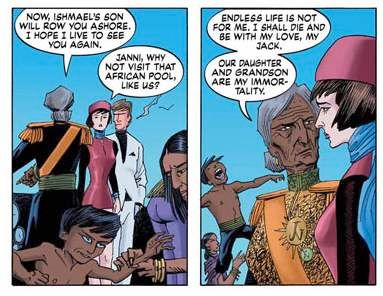


Every one tends towards their own state of rest, to paraphrase Matchbright, and either consciously or not we edge towards that condition that requires the least energy to maintain. It is therefore no coincidence that when we first see Janni it is to find her naked and unembarrassed, carefree and at ease - right up to the point where Ishmael appears with her father's summons. Later renouncing, as far as she can, her own heritage, she swims out to sea to a passing schooner. When next she returns to the mantle of Nemo, it is after she has been violated by the very hands of those her father despised most, so that even as the drawbridge of the Nautilus closes up and the vessel swallows her whole, we are left with a feeling that her story is far from over, and that what we have seen is little more than a temporary respite from the impetus that led her to leave from Lincoln Island in the first place.
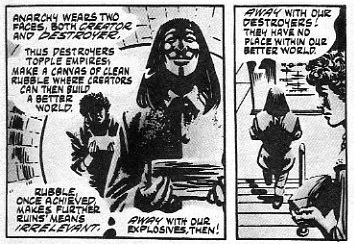


I don't know if this panel left with me a strong enough impression upon first reading, although by the end of V it had certainly taken on a whole new meaning. It was only much later, when recoiling from the effects of V, that it occurred to me that I wouldn't mind reading about Evey Hammond's subsequent adventures, the challenges she would face as creator rather than destroyer, simply because it was always so much easier to fight *against* something, as evidenced by every other comic on the market; I was sure, even then, that no one else would be able to write something like that.

Lincoln Island, in occupying the part of what could be considered North Korea in the world of the League, minus all the political alliances (but not matrimonial ones), appears to remain the underdog throughout the entire fourth volume of the League series. They will always be the Destroyer, the thorn in the side of the Empire, keeping true to Prince Dakkar’s split from England as promised at the end of Vol II.  By the time we reach 2009, Prince Hira seems more than keen on continuing this line of the Dakkar dynasty, and it is only in Janni’s lifetime that some other facet of the Nemo legacy is revealed. Given how bleakly the rest of our cast has turned out, I think that a welcome development.

It is her adventures, therefore, that picks up where Evey Hammond’s left off.

Before that she still has one more thing to see to.

In Heart of Ice Janni has grown tired from walking in her father's shadow since reclaiming her birthright, 15 years ago; so much has passed her way since then, in fact, that she has become more than a little jaded, her own history capped off by those two events that, however long ago, still inform her entire character: her escape from Lincoln Island, and her rape by the English. Subconsciously, we wonder if she hasn't been looking for some way out when, almost on a whim, she announces her intention to revisit one of her father's earlier, failed expeditions. (Far from a whim perhaps, but the story's short format makes it so – and my only complain about the installment; who would not have loved to see more perspective shots of the Nautilus, A LA the Carrier in the Authority?)

Yet there is more to this than a passing fancy. She has, by Ishmael's account, outdone her father and, by her own hatred for the English as well as her agency of the Nautilus, given form to that sentiment (two qualities that Prince Dakkar also possessed); in short, Janni has come as close to being like her father as she possibly can. Yet something is amiss. Outwardly she tells Broad Arrow Jack that she is tired of looting, and yearns instead for adventure, except that perhaps there is some part of her that wonders how differently life would have been for her father -and so her- if he had spent more time adventuring instead, and if his most glaring of failures had turned out otherwise.

Of Prince Dakkar's own trek through the Mounts of Madness we have only his account from Volume II's New Traveller's Almanac to go on with, and Kevin O'Neil’s rendition of Janni's adventure in Heart of Ice seems to mirror her father's journey for the most part, except for one difference: where Prince Dakkar entered the Antarctica bitter and angry about his wife's not giving him a son, and emerged maddened and incoherent with his disappointment intact, it is his daughter who, seeking adventure and escape, ends up finding for herself a new life instead. Yet this involved her choosing as well; close to the end when Janni reflects on her escape, we see an unnatural lens turned towards her deceased father, whose time and era she reasons as no longer her own, when perhaps she wonders instead why the the same journey that made her change her life did nothing to endear her father to the daughter he never wanted.

It is easy to ascribe Janni declining Mina's offer of immortality to the effects of acceptance itself, when one sees one’s end as a natural course of things, although I believe the full effects of this decision will only be revealed to us much later, in the next two standalone installments of her adventures. Janni's affection for Jack, while not as overt as that between Murray and Quatermain, is of course the main reason cited, although having seen how things have turned out in 2009 for our immortal couple, a lot stands to be played out between Captain and first mate here. For some reason I now recall Orlando's depersonalization across the ages, whose attributes come down to fucking, fighting, and perhaps, “Sinbad was the only person I ever loved”, with even that going straight to Hell in the opening pages of 2009. To be fair, of the three, only Murray gained her immortality willingly; Orlando did it without knowing, and Quatermain because he was about to die. Yet, if there is anything that Century has shown us, it’s that, far from what is gained through immortality, it is what's lost that really matters.

Looking forward to Roses of Berlin.

Saturday, 1 December 2012

Alan Moore & Mitch Jenkin's Act of Faith


Utterly, utterly delicious. Watching this reminds me also of Moore's proposal for Twilight of the Superheroes, specifically the first part about the seedy motel. Twilight never got made, but it seems like some ideas hang around for very very long. Maybe it's because I don't watch that much film, but I found this really refreshing, firstly in terms of pacing, and then the palpable sense of mood. On a story level it works on the secondary level of Faith's front page piece that brings out dirt into the open, which is, of course, a fantasy she enacts later in her own private life.

Amano in Tenjin

Amano Billboard

Picture of a billboard done by Yoshitaka Amano. Here's a close-up:


Amano Billboard close-up

The blue panel to the side splits the painting, but it is also a panel in the picture itself.

Goliath Falls


Goliath Falls on Nature, a week ago.

Thursday, 11 October 2012

Alan Moore & Kevin O'Neil: CENTURY

Despite Alan Moore's direct admission of how culture itself becomes the focus in the now complete three-volume instalment of the League of Extraordinary Gentlemen: Century, the extant to which this one claim has been pursued in the actual storyline is still full of surprises.

The anti-Christ, an Empire of No One, regressive characters and the end of dreams. Perhaps one of the more obvious places to start would be in some mystical pool in present day Uganda.

In the Black Dossier, we are first introduced to Orlando, who, in his/her era spanning adventures, encounters a magical pool that bestows immortality onto any who would bath in its waters. We later learn from the Dossier that Allan Quatermain and Wilhelmina Murray do the same, and it is what our two heroes here gain that becomes the background that Century is set against. Immortality is no easy condition, and riding out of time we learn that not everything can survive the journey.

There is a part in the last volume of Century, 2009, when Orlando makes a casual comment about something the Mina had missed in the forty year period that she had been forced to spend in the Coote's Centre, and an expression comes across Murray's face that is too well-realized for it to be unintentional. It is only one bit in a string of instances wherein Mina shows how uncomfortable she has become with the idea of immortality, but it is by far the most telling; since dipping in the pool the characters risk complete detachment from humanity, and at one end we have Mina, who is desperately trying to tie herself down to some specific context, and at the other end we have Orlando, who recounts the past to Mina like the synopses of missed TV dramas.

Of all the characters to appear in Century, Orlando is, by his own admission, the most shallow, personified only by those two eternal and extreme aspects of the human condition, lust and aggression. Despite the three millenia that he has survived, he is the least in control of himself, as depicted in 2009 when he initiates the massacre, and 1969 (or rather 1976) when he gives up the search for Murray (unlike Quatermain, whose reasons for doing so are simply because he is weak, a difference that we will return to). He is also the one most likely to reflect the state of culture that he happens to find himself in. He bears, as shown in the Black Dossier, no allegiances, happily throwing in his lot with whomever his whim suits him, and claims that he wouldn't change a single thing, when, if his behaviour in 2009 is anything to go by, we wonder if he truly can.

Consider then, Exhibit B, Miss Wilhelmina Murray. Indeed, if there is anything that holds Century together as it charts the rise and fall of culture and fads, it is Mina's resolve to stick to the plan of stopping Haddo's Moonchild, as well as the urgency that seizes upon her when she realizes that she has stopped aging. She acts where Orlando cannot, and where Quartermain dares not. Between Orlando admitting to his own personal vacuity, and Quatermain crumbling beneath the weight of too much reality, we see the break of culture reflected off these characters. From the very moment that Orlando is ordered (by Prospero, and not himself) to do something about the situation we see an instant change in his character; it is as though he gets a whiff of the Mina personality, and, more than simply play up to his knee-jerk role of the 21st century ('Help the homeless...miss?' 'Get a job.'), part of him surfaces into character. Even the bit at the front where he adds a belated '...sir.' when asked about the massacre is very telling; he may be immortal, but years of being a survivor has made Orlando just that and nothing more.

As far as culture goes, however, there is a bit more than the three chosen periods that we have been presented in Century; another theme has been addressed here, hopping around in different guises, and that theme is tradition. Traditions, passed down and perpetuated from one generation to the next, can be argued as one of the less malleable aspects that in turn affects the topology that culture adopts. And those who would challenge its hold never seem to find a good end until returned back to the fold of the very thing they ran away from. Janni Diver, the anti-Christ, both children who rebel against their given birthright, both somehow driven to stop the course of culture, only for one to become the worst of what she opposed ('I'll tell you what Jack, she's worst,' says Ishmael) and for the other to become nothing but a flimsy angst-ridden, haloperidol popping poster boy of his age, rather than the glory of whatever apocalyptic figure he could have been had he accepted his role. Culture, more than merely deciding, enforces the destinies of our characters.

And if tradition is that aspect of culture that seeks perpetuity, then certainly a third story awaits in the telling, and that is the story of Wilhelmina Murray, and how she will address the very notion that seeks timelessness, when she herself has become timeless. Century does not end with 2009 so much as draw our attention to that which seems most deserving of our attention: how to spend our time and what it means to be given a life. The answers, we hope, will come later.

Even the most stoic reader who must insist on a 'who won?' analysis to their stories cannot walk away from Century without feeling that the standard plot had somehow been overturned, and the final showdown between the anti-Christ and Prospero/God/Mary Poppins nothing more than a passing distraction, commentary masquerading as a fad. When even the oldest of evils is brought to kneel, then perhaps Haddo is right to say that Murray has ushered in their own age of apocalypse, which probably is not as bad as it seems, since apocalypse, as Moore points our often enough, means revelation.

("This is a traditional apocalypse." Says Orlando to the I-may-be-old-but-I-am-still-hot-M (emphasis mine), in a scene that shows how flimsy end-of-world scenarios have become. Even the Apocalypse comes in flavours.)

That leaves just one final question, then. Where is my moon over Soho? Moore has never shied away from the non-glimmery aspects of humanity, and in the three slim volumes that make up Century the readers are dragged through violation, disillusionment, lost, regression, and finally, insanity. I would add death to the whole lot, except that I'm sure that most readers were more than glad to see one final spurt of life from our elephant-gun wielding hero from days of yore, instead of the dead person he had already become. Where Murray chooses to continue on with the plan of stopping Haddo, Quatermain chooses instead the jungle of his own sanity. In this way Quatermain comes to embody that period of 1969 most succinctly, as he experiences disillusionment first at his own failure to live up to his reputation, and then projects outwardly at others when this is pointed out to him.

Looking a little closer, however, we see that what has happened is that Quatermain (without being completely aware about it) has come up against that one question that Murray has been exempted from during her 40-year stay in the Coote's Centre: that of identity, and who he is. It is their roles reversed at the end of Book 2, after the Martian invasion, only this time it is Quatermain who has been forced into introspection. Identity of self takes on a different meaning when viewed through the scope of one now able to live through centuries (or millennia, in Orlando's case); and through Quatermain we see him struggle against his drug-addiction in an ugly tug of war between man vs conditioning/meme, when others like Orlando and Captain Cuckoo seemed to have long accepted themselves as vectors of war.

(Murray's own struggle in the Coote's Centre is hardly a fair comparison, as she tries to anchor her identity in the here and now while Quatermain is subjected to a real passage of time. One gets the impression that her 40 years are like one sedated spell, leaving her a scared mouse a bit too eager to jump, but still able to pick up where she left off. Quatermain, on the other hand, is worn by time we next meet him, and has had no one to anchor onto, be it in memory or, in this case, Mina. Yes, he was on drugs on the outside, but it is the awareness that separates him from Murray.)

Personally, the most heart wrenching part of Century for me is the little sing-along that Murray and Quatermain carry out in 2009; an inevitable parting of two lovers so far removed from each other, it is nonetheless the tune of the Beggar's Banquet in the background that drives the point home. We are back in 1910; yes, we had a good, colourful spurt of life in 1969; where did everything go wrong? Immortality makes everything harder to measure, and ideals hard to realize over one lifetime becomes nigh impossible when stretched over eternity. That is perhaps what makes Murray next adventure so exciting: we want to know what answer Moore may have beyond the ones that we have been presented with so far.

However the story will turn out, it is nonetheless warming (in the heart, of all regions) to know that stories beyond 2009 will involve a particularly robust cast of immortal ex-Bond girls, which would of course make for an extraordinary league all by itself(albeit one of women, but you already knew that).

And that was just me, thinking out loud. Just don't ask me about the references.

An addendum:

On top of the whole theme of immortality that permeates the Century series, there is another less obvious story being played out, hinted but here and there but most obviously in the opening page of each volume. It is the Triton, symbol of Poseidon, but here, Nemo, and the new era ushered in by Janni Dakkar, who could very well be the moonchild that Karnacki dreams about in volume 1 (Yeah, I know right? How obvious can you get, have Karnacki finish off with that key word and whoop - next page, naked girl, 'naked' as in 'innocent', as in 'child', and sure let's just hang a moon over her, why don't we?). We see the birth of her ideology in 1910, its extension in 1969 when she tells Murray that, 'Our daughter and grandson are my immortality,' and its fruition into 2009 and beyond come volume 3.

The true disaster envisioned by Karnacki isn't the bombing of the docks, but the passing down of the Nemo namesake that will only grow stronger with time. That gives us another story to look forward to, and a context by which we will be able to place the story of the moonchild in Nemo: Heart of Ice, instead of merely dismissing it as some tangential, 48-page special.

Lastly, and man I promise I'll stop with this, I think with the League now, Moore seems to be directly addressing the immortality of franchise characters. In the same way that he had examined the power of superheroes as it approximates god-like proportions in Miracleman, Moore is a now asking, "What would it really be like for a character to live through a world where time passes, but only not for them?" This is, of course, what makes Moore so cool: how he always manages to bring a fresh angle to an otherwise dull subject. And while there *probably* is a story in the Silver Ages somewhere about Clark Kent struggling with his internal doubts and his own eternal youth, it hardly matters in a world where everyone else too is young, and by the time we reach issue #1,000 there will still be a Lois Lane and yes, a ma, a pa (dying again, I shouldn't wonder) and Krypto, all going at it has before. 


Sunday, 8 April 2012

ULTRAMAN SAGA


Saw ULTRAMAN SAGA earlier this evening, and in 3D no less, which actually works very well with the sometimes cheesy but all too apt effects of the movie. I went in thinking it will be kooky but came out... a believer again. I haven't seen an Ultraman show since I was wee, when my dad would bring back these taped episodes for me from being posted in Sabah for his internship(they were in Malay, so no, I could not understand them).

Go out with me this Friday? Pleasepleaseplease?

MIDNIGHT AT THE A&E - up now at FUTURES